
-
 James_Spiegel
-
Main Account
-
Forums
-
Write what you are looking for and press enter to begin your search!
James_Spiegel
Main Account
Forums


You've made the decision to skip the traditional university route. You're teaching yourself the skills that matter, building projects that prove your worth, and racing toward that graduate-level salary without the degree. But there's a critical variable most self-learners ignore completely: their finances. And that blindness? It's sabotaging everything you're trying to build.
Here's the uncomfortable truth: while you're obsessing over mastering Python or perfecting your portfolio, your financial chaos is creating a psychological prison that's quietly destroying your momentum. The money you're not tracking isn't just invisible, it's actively working against your career aspirations. This blog post will show you exactly why financial metrics matter for self-learners, how to establish a tracking system that actually works, and most importantly, how financial ignorance becomes a career-limiting ceiling that most self-learners never break through.
The Financial Metrics You Must Track
Most self-learners think tracking means knowing "roughly" how much they're spending. This vagueness is precisely where career growth goes to die.
The first metric you need to obsess over is "monthly skill investment spend". This includes every course, platform subscription, book, and tool you're buying to build your capabilities. Not the estimate, the exact number. Divide this by the hours you're actually investing in learning. You're not just looking for total spend; you're calculating your cost-per-learning-hour. When you see that your YouTube-based learning costs you $2 per hour but that premium course cost $47 per hour, you gain clarity about resource allocation. This becomes critical when money tightens.
The second metric is "runway clarity". This is your monthly living expenses divided into your current savings. If you're self-learning while also building a side income or working part-time, you need to know exactly how many months you can sustain this lifestyle if everything stopped today. Not a rough guess, the actual number. This single figure determines whether you're making ambitious decisions from a position of security or desperation.
The third metric is "opportunity cost ratio". Calculate what you'd earn in a standard job versus what you're currently making (if anything) while self-learning. The gap between these numbers is your true cost of self-learning. Some self-learners are losing £15,000 annually to pursue this path. Knowing this number doesn't mean you should quit, it means you can make intelligent decisions about time allocation and intensity.
The fourth metric is "portfolio-to-spend ratio". How many completed projects have you built for every £100 spent on learning resources? This reveals whether you're spending money on learning or just collecting courses. Real career advancement comes from the projects, not the purchases. Track this ruthlessly.
Finally, track your "conversion metrics": applications sent, interviews secured, offers received, correlated against your learning spend and timeline. This isn't vanity; this is the actual performance data that tells you whether your financial investments are translating into career momentum.

How Often Should You Track Your Spending?
Here's where most self-learners get it wrong: they either obsessively check daily or forget about it entirely for months. Both extremes sabotage you.
You should conduct a daily micro-check. This takes three minutes. Every transaction gets logged immediately, not to an app that you never review, but to a simple spreadsheet with just three columns: date, category, amount. This isn't about budgeting discipline; it's about maintaining a real-time feed of reality. Your brain needs current information to make good decisions.
The weekly deep dive is where the real power lives. Every Sunday (pick a consistent day), spend 30 minutes reviewing the week's transactions, recalculating your runway, and most importantly, assessing whether your spending is aligned with your career goals. Is that £15 subscription still serving your learning objective? Are you eating out more than you realize? This weekly rhythm prevents small leaks from becoming sinkholes.
The monthly strategic review is your decision-making checkpoint. This is where you step back and ask the hard questions: Am I on pace to land that interview before my runway runs out? Is my spending on learning actually producing tangible portfolio additions? Do my financial constraints require me to pivot my learning strategy? This monthly session should take 90 minutes and result in one or two concrete decisions.
Quarterly reviews give you perspective on patterns. Every three months, look back at your metrics, trend your data, and ask whether you're accelerating toward your goal or drifting sideways while spending like you are.
How Financial Blindness Blocks Career Growth
This is where the psychology becomes brutal. When you don't track your finances, you operate in a state of constant, low-level anxiety. Your brain knows something is wrong, but because you haven't faced the actual numbers, you can't articulate what it is. This anxiety does three devastating things to your self-learning journey.
First, it destroys decision-making velocity. Self-learning requires making hundreds of micro-decisions: which course next, which project to build, whether to attend that networking event, whether to rebrand your portfolio, when to start applying for jobs. Financial blindness means these decisions are subconsciously colored by fear. You'll pick the cheaper option even if it's inferior. You'll delay the expensive-but-necessary portfolio project. You'll avoid networking events because you're uncomfortable about your financial situation. Each individual decision seems small, but cumulatively they slow your momentum by months.
Second, financial blindness creates credibility gaps in interviews. Even if you don't mention money, interviewers can sense desperation. When you're financially anxious, your interview presence changes, your answers become more cautious, your confidence wavers, your enthusiasm reads as slightly off. Employers detect this unconsciously. Meanwhile, the self-learner who knows their financial runway and can articulate their learning investments shows up as composed and intentional. That difference influences hiring decisions more than candidates realize.
Third, and most importantly, financial ignorance prevents strategic pivots. Your learning path isn't a straight line. Sometimes you need to invest more money to accelerate (hiring a mentor, taking an intensive program). Sometimes you need to switch strategies entirely because the market has shifted. These pivots require decision-making clarity that only comes from knowing your numbers. Without this clarity, you're stuck in reactive mode, taking whatever free or cheap option appears, rather than strategically investing your scarce resources.
The most insidious effect? Financial blindness creates a ceiling on ambition. When you don't know your numbers, you don't know what's possible. You can't calculate whether you could afford a three-month intensive bootcamp if you cut living expenses. You can't assess whether hiring a career coach would be worthwhile. You can't plan a strategic timeline. Your career growth becomes random rather than intentional, and randomness is the enemy of rapid advancement.
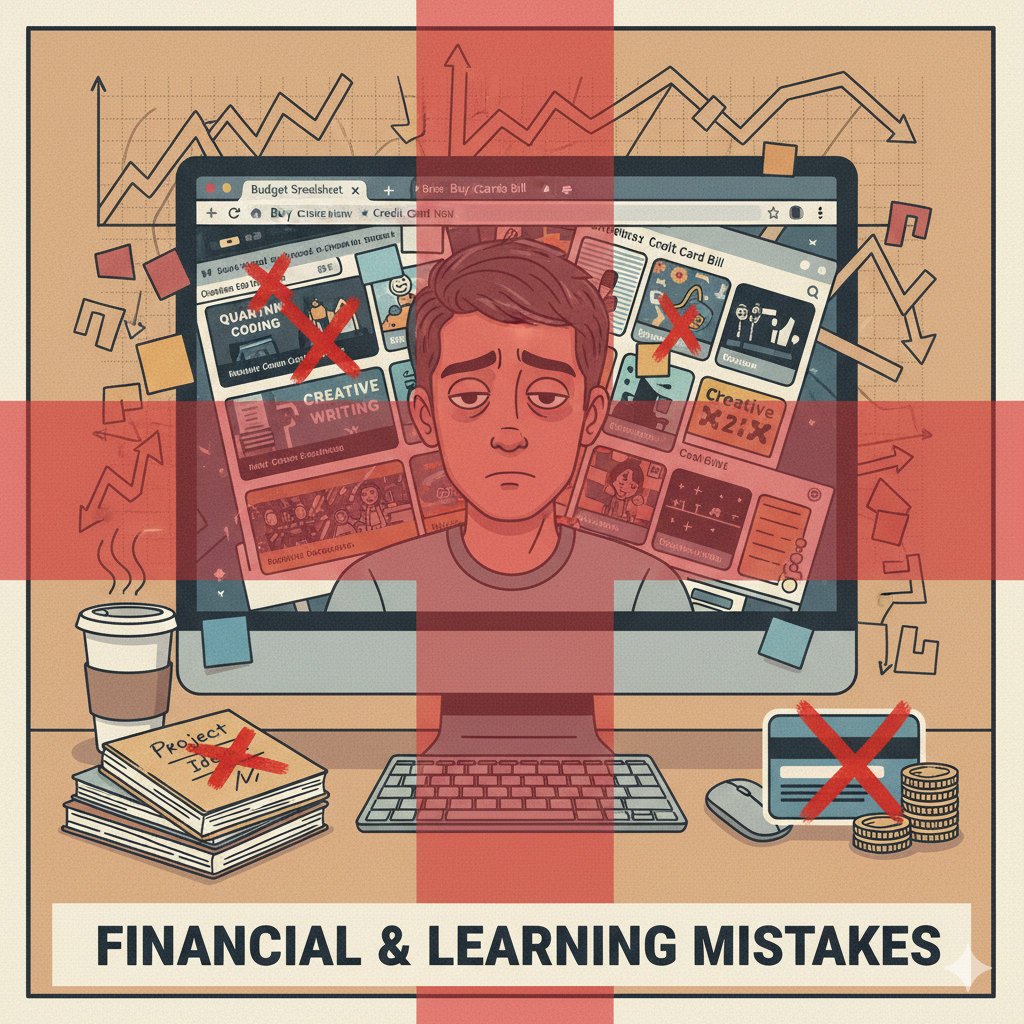
What Not to Do When You're Financially Strapped
When money gets tight and it will, most self-learners make catastrophic decisions that extend their timeline by years.
Don't abandon your learning to maximize short-term income. The self-learner who spends six months working three jobs to save £5,000 while barely maintaining their learning has made a poor trade. You're swapping time (your most valuable asset when learning) for money. Six months of focused, disciplined self-learning is worth more to your career than £5,000 in savings. If you must work to fund yourself, work strategically; part-time roles that pay well for minimal hours, or roles that actually teach you relevant skills.
Don't spread yourself across too many learning resources simultaneously. Financial pressure tempts you to buy every course that might help, hoping something sticks. This is the opposite of what you should do. When money is tight, you need extreme focus. One excellent project built from free resources and one paid course beats five half-finished projects across ten courses.
Don't compromise on the fundamentals of your portfolio. Some self-learners, stressed about money, rush through project building or cut corners on quality. Don't do this. Your portfolio is your resume. One exceptional project built with care is worth infinitely more than three mediocre ones. If you're financially strapped, build fewer projects, not lower-quality ones.
Don't hide from your finances hoping they'll improve. Some self-learners avoid tracking because they know the truth will be uncomfortable. This is backwards. The uncomfortable truth is exactly what you need. Once you face your financial reality, you can make intelligent adjustments. Living in denial just extends the suffering.
Finally, don't accept poverty as part of the self-learning narrative. Some self-learning communities romanticize financial struggle as a badge of commitment. Reject this completely. Your goal is a graduate-level salary, not sainthood through suffering. Being financially strategic isn't selling out; it's being professional about your career transition.
Conclusion: Equip Yourself for the Next Phase
Financial blindness isn't a personal failing; it's a skill gap. And unlike many skills, this one is genuinely easy to develop. What separates self-learners who land competitive roles from those who spin their wheels for years is rarely their technical ability, it's often their willingness to face their financial reality and use that information to make better decisions.
By tracking your skill investment spend, runway clarity, opportunity cost ratio, portfolio-to-spend ratio, and conversion metrics (weekly and monthly), you transform from someone hoping things work out into someone executing a plan. This clarity doesn't just improve your finances; it changes how you show up in interviews, how you prioritize your time, and how you navigate the inevitable pivots your learning journey requires.
Key powerful takeaways to move forward:
Track your exact metrics weekly and review strategically monthly. This isn't bureaucracy; it's the data foundation for intelligent career decisions. Know your runway to the month and your true opportunity costs to the pound. These numbers determine what's actually possible for you. Align every learning investment with portfolio output—what matters for career growth is projects, not course completion certificates. Treat financial management as a career skill equal to any technical skill you're developing. When money gets tight, focus harder, not wider. Strategic intensity beats scattered effort. Finally, remember that financial discipline isn't the enemy of ambition—it's the fuel for it. The self-learners who hit their targets fastest are almost always the ones ruthlessly tracking what they're spending and why. Track or be trapped. The choice is entirely yours.

IntroductionThe traditional path to career success—degree, internship, entry-level role—is broken. W...

IntroductionThe traditional pathway to career success—university degree, internships, entry-level po...

IntroductionIf you're tired of watching your degree-holding peers land entry-level positions while y...

Empowering Personal Growth Together













jNIXsbxhMrrtoDdcnPYjcZyi
Yes https://topolakd.net
rsrd\jzfdnzfd vbfdxb
swfewqfv sht n
Accountability is key to growth, and sharing your journey publicly adds a whole...